Let's explore with Leonix the "gaps" that are silently eroding the profits of many event organizing companies today and the solutions that help businesses manage profit margins and operational efficiency in real-time rather than just evaluating results after the project has ended.
I. Event Organization Market
Event Organization Market
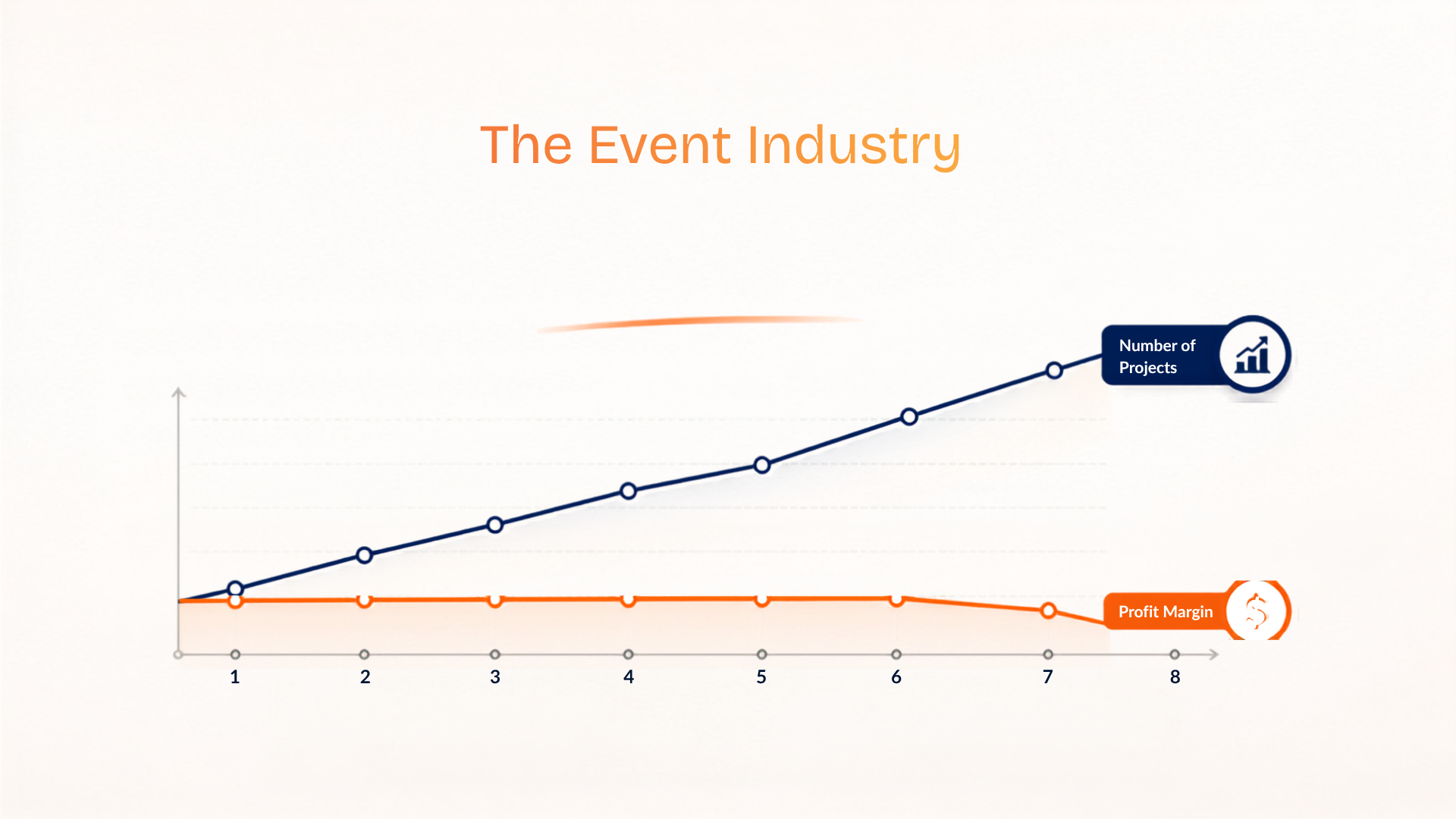
The event organization market in Vietnam is witnessing a strong explosion in scale and the number of projects. Many businesses can effectively manage 5-10 projects at the same time. However, when this number increases to 20-30 projects, weaknesses in the process begin to appear.
This wave of growth has actually become a core problem of managing profit margins that event organizing companies must solve if they want to expand sustainably.
II. 5 Gaps in Business Profit Margin Leakage

5 Gaps in Profit Margin Leakage
These five issues often resonate with each other whenever the number of projects increases, causing businesses to leak profit margins after each project.
2.1 Profits Eroded After Each Project
One of the most common reasons for profit decline is unexpected expenses, including costs for hiring additional personnel, equipment expenses, changes in customer requirements, or adjustments to implementation items, which are often only compiled after the event has concluded.
The concerning thing is that these expenses often appear in multiple projects at the same time, causing real-time control and updates to be compromised. As a result, it erodes the target budget and loses the opportunity for reinvestment in new projects.
2.2 Loss of control in the implementation of ideas
The lack of standardization of the resource checklist for each phase has led to a fragmented implementation of the concept. As a result, the original idea is not fully conveyed during the execution, deviating from the initial objectives.
2.3. Breakdowns in multi-channel information
Many businesses still operate on various separate tools: CRM for customer management, Excel for budget tracking, chat groups for coordinating personnel, and other independent project management tools,.... As a result, information is fragmented between departments, suppliers, and customers.
When data is fragmented, businesses lack a dashboard for management to monitor the progress, cash flow, and actual status of multiple projects simultaneously.
2.4 Ineffective event metric measurement
Many businesses organizing events do not have a set of metrics and accurate data collection tools before, during, and after the event.
This leads to a lack of data to demonstrate return on investment (ROI) to clients, missing out on good project bidding opportunities without a basis for improvement for future projects.
2.5 Each new project adds hours of manual coordination
As the number of projects increases, the operations team has to spend too much time on assigning tasks and tracking personnel hours.
As a result, the business lacks resources to focus on optimizing customer experience and managing risks at events.
III. Why Odoo ERP helps achieve sustainable growth

Three-tier process for sustainable growth
With the Odoo ERP platform featuring centralized data, automated processes, comprehensive integration, security & transparency, and real-time reporting, the three-tier process helps businesses organize events from fragmented operations to controlled growth.
Level 1: Streamlining operations
This is the foundation for operating multiple projects with the same resources and consistent implementation across projects, even with different execution teams. The process needs to be streamlined enough to coordinate smoothly, maintain consistent quality, and not rely on the memory of a few key individuals.
Level 2: Business Efficiency
Once operations are stable, the business is qualified to control profits on a per-project basis rather than only looking at results after each project ends. Centralized and transparent data helps leadership make decisions faster while also detecting projects that are running at a loss while they are still ongoing, rather than after they have concluded.
Level 3: Sustainable Growth
Only when the two lower levels are solid can the event organization have a sufficient foundation to scale: taking on more projects without increasing management complexity or hiring additional staff accordingly. This is the state of sustainable growth, where scale, quantity, and project profit margins are all optimized and improved.
IV. Comprehensive Solution Model

Comprehensive solution model
With Odoo ERP platforms, the entire lifecycle of an event project is digitized into a continuous data flow: from the moment a lead is received to the closing report after the event. Specifically as follows:
Lead: All customer needs are standardized into a unified sales process.
Proposal: Update synchronized bidding prices on a single quotation table without editing multiple files.
Planning: Personnel, props, and run-of-show are finalized before D-day.
Execution: All changes that arise are updated and recorded in real-time.
Invoicing: Reconciliation is generated according to the budget, and invoices are automatically issued for each project phase.
Reporting: P&L after each event is converted into input data for subsequent quotes.
V. Implementation Scope
5.1 Customer & Bid Management
Design the sales/bidding process according to a unified flow and closely monitor each stage.
CRM & Pipeline to track opportunities and prioritize projects in a timely manner.
5.2 Equipment Depreciation Management
Track the history of equipment usage.
Plan the preparation of props according to the event.
5.3 Profit Margin Management
All income and expenses are recorded throughout the same project file.
Dashboard comparing Budget vs. Actual Expenditure (including additional fees), early detection of deficit projects before completion.
5.4 Guest & Personnel Management
Coordinating personnel according to the right shift, the right task, at the right time.
Providing registration portal tools and QR check-in to reduce the burden of reception.
At Leonix, we believe that in the event organization industry, profits do not disappear in one large place but rather leak gradually through dozens of small decisions that are not recorded in real-time. A centralized data system is essential for expanding profit margins.
Explore the Solution for Event Agency
VI. Conclusion
Sustainable growth for event organizing businesses is not just a slogan, but the result of following the right order: streamlining operations first, controlling business efficiency for each subsequent project, and then scaling up. To achieve this, the data for the entire project lifecycle needs to be on a single platform rather than fragmented across multiple files and departments.
If your business is facing similar issues in managing profit margins, consult with Leonix experts to assess the current operational system and work together to find suitable solutions for sustainable development in the future.