
I. Digital Transformation in the New Era
In the context of increasingly widespread digital transformation, the biggest challenge for businesses is not just digitizing processes but optimizing operations based on internal data. However, many current ERP systems still stop at data storage and recording features, lacking automation and proactive decision support.
This leads to a series of operational issues such as data delays, reliance on manual operations, accounting errors, and a lack of real-time control over field teams. These limitations, along with the increasingly complex operational demands of businesses, are driving ERP solutions to shift towards a more proactive approach, improving efficiency. At Leonix, we believe that an effective ERP system is not just about data storage capabilities, but about helping businesses respond more quickly to operational changes.
II. Overview of Odoo and Odoo version 19.3
Odoo is a comprehensive open-source enterprise resource planning (ERP) software suite that is popular worldwide due to its flexibility, scalability, affordability, and optimal efficiency in business operations. Odoo versions are continuously updated with improvements and feature expansions to meet the needs of optimizing the user experience.
Odoo 19.3 was launched in May 2026 with a series of comprehensive improvements across all aspects of the platform, from building websites using artificial intelligence and a richer mobile user experience to expanding localization support for over 25 countries and a completely revamped accounting tool. The official launch of this version is seen as a significant milestone in marking the proactive role of the ERP system in supporting business operational decisions.
III. Notable new features of Odoo 19.3
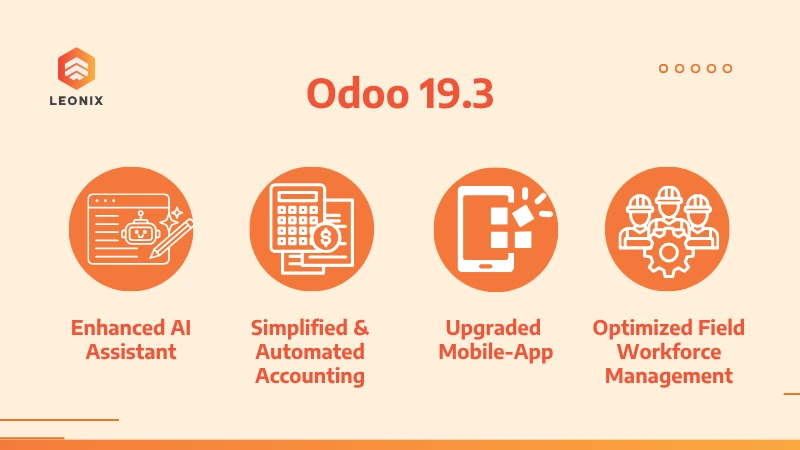
Key features of Odoo 19.3
3.1 Significantly upgraded AI assistant
AI now not only assists but actively performs tasks as requested by users quickly and comprehensively, significantly speeding up the workflow. Specifically, the AI assistant in Odoo 19.3 can automatically create and update profiles and records when users upload files (PDFs, guides, etc.). At the same time, this AI assistant can also create images, highlight buttons for the website (CTAs), and emails as requested, all stored in a chat interface.
3.2 Accounting changes due to simplified account structure and automated processing
Odoo 19.3 comes with significant changes in the Accounting area. The account structure is more intuitive and flexible as Parent Accounts replace Account Groups, and account codes are no longer mandatory. The feature for automatically handling foreign exchange differences in the balance sheet (Cumulative Translation Adjustment) has been updated, providing a significant advantage for multi-currency businesses. Additionally, Odoo 19.3 allows for individual invoice payments and batch payments with a single signature directly on Odoo through the new PISP interface (Payment Initiation Service Provider), streamlining the payment process and reducing data errors.
3.3 Upgrade of the call group feature (Mobile app)
This feature allows for call transfers between devices even while the call is in progress without interruption, suitable for mobility and switching devices as needed. It also allows for simultaneous calls, utilizing a floating softphone - a drag-and-drop utility that remains visible even when working on other applications.
3.4 Optimizing field team planning and management
Odoo 19.3 allows for assigning materials to personnel/shifts (Assigning materials), helping to standardize work and avoid errors when materials are lacking during work. The system also includes functions to optimize travel routes, a live map, and a feature to measure customer satisfaction after each service to assess, control, and optimize processes and on-site work efficiency in real-time.
IV. Opportunities and challenges for businesses using version 19.3
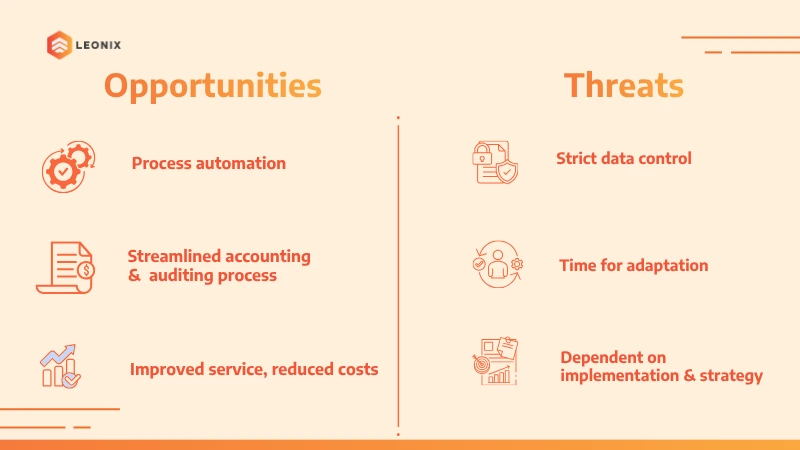
Opportunities and challenges when using Odoo 19.3
4.1 Opportunities when using Odoo 19.3
Helps businesses automate operational processes
AI features go beyond just support; they can directly create data, update records, and design content, significantly reducing the workload of manual tasks and enhancing overall productivity.
Helps businesses simplify the auditing process.
Businesses reduce reliance on manual operations, minimizing errors thanks to improved features in accounting, facilitating multinational companies or those operating with multiple currencies.
Helps businesses enhance service quality and optimize operational costs.
Thanks to features like live maps, optimized routes, and measuring customer experience, real-time field management capabilities are managed optimally and effectively.
4.2 Challenges when using Odoo 19.3
Tight data control.
Although AI and key functions in accounting, planning, and field control help proactively optimize and automate operational processes, businesses need to measure and control data tightly and more optimally to be proactive in operational management rather than completely relying on the system.
Inadequacies in adaptation.
Changes in accounting structure and system operation can cause teams to face difficulties in the initial stages, especially for businesses accustomed to the old system. This requires time for adaptation and training.
Dependence on implementation processes and business strategy.
Fully leveraging the potential of Odoo 19.3 largely depends on the implementation capabilities and digitalization strategy of the business. Without a clear direction, the business may not fully exploit the value of the system, leading to wasted resources.
IV. Conclusion
The launch of Odoo version 19.3 opens up significant opportunities for businesses in their digital transformation journey and operational optimization, but it also presents fundamental challenges during the implementation process. This process requires proactive control, measurement, and optimization from the business to fully leverage the effectiveness of the new features of the system.