Let's explore with Leonix the reasons why more and more Commerce businesses are consolidating their entire processes from multi-channel sales, warehousing to finance into a single data platform. Is this the key to sustainable growth for Commerce businesses?
I. The Modern Trading Landscape
1. Opportunities Accompanied by Pressures When Expanding Distribution Channels
The Need to Expand
To grow, trading enterprises must expand their sales channels from showrooms, agents, telesales to e-commerce platforms. The pressure lies in the fact that the current system does not ensure smooth operations and maintain profit margins.
As transaction speeds increase, even a 1-2% discrepancy in inventory or discounts can wipe out a month's profit.
Two Concurrent Pressures
Response Speed to Demand: must maintain sufficient inventory to quickly meet requests from multiple channels while avoiding tying up capital in non-moving stock.
Protecting Profit Margins: competitive market, thin profit margins, small discrepancies in inventory or discounts can easily lead to profit loss.
2. Each Management Tool Forms a 'Data Island'
The system based on dozens of Excel files, notebooks, standalone software, and messages has reached the end of its lifecycle. Three signs often appear simultaneously:
Bulky and Fragile: Excel is overloaded, slow to load, prone to formula errors, and very difficult to secure permissions.
Decision-Making Delays: no real-time reports, leaders must wait several days to manually compile data.
Risk of Personnel Dependency: processes reside in the minds of personnel, not in the system. If key personnel leave, operations come to a halt.
II. 5 Bottlenecks Eroding Enterprise Profits
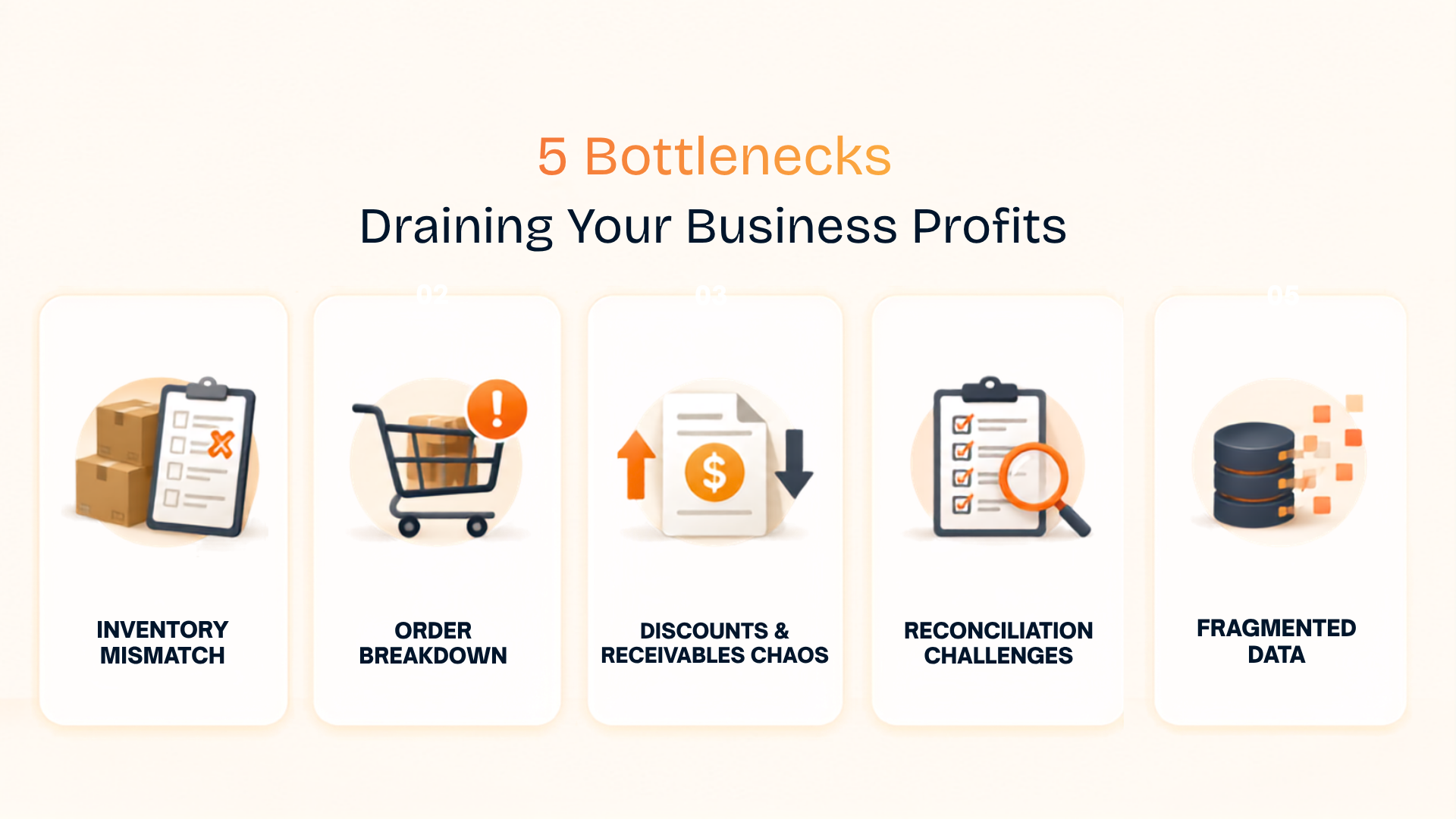
5 bottlenecks eroding business profits
Many trading companies still do not realize: "Profit is not proportional to the number of sales channels" because businesses still operate on disparate systems, lacking a common data source. The 5 bottlenecks eroding business profits include:
2.1 Inventory mismatch
When businesses lack real-time visibility in managing by warehouse and channel, it leads to stockouts in some places and excess inventory in others, not knowing where to push or release stock.
2.2 Order breakdown
Orders from telesales, showrooms, and platforms come in from various sources, leading to stock shortages and an inability to measure the effectiveness of each channel.
2.3 Discounts & chaotic receivables
Price lists and regional discounts run on Excel, leading to overdue debts that sales are unaware of, continuing to sell.
2.4 Difficult reconciliation
Many payment methods, manual reconciliation, requiring order and payment recording across multiple platforms.
2.5 Fragmented data
Data from sales is managed in one file, accounting data is in another software, and inventory is managed with a different spreadsheet, causing reconciliation to take many days and increasing the risk of revenue errors..
III. Benefits of synchronizing data with ERP

Benefits of synchronizing data with ERP
3.1 Make decisions based on real-time data
All data on revenue, inventory, orders, receivables, and cash flow is updated in real-time on a single dashboard, helping leaders respond quickly to market fluctuations and allowing businesses to detect early discrepancies that could impact profits.
3.2 Eliminate "data silos" between departments
Information is seamlessly transmitted from Sales - Purchase – Inventory – Accounting. Data is entered only once and automatically synchronized between departments, reducing discrepancies and repetitive data entry.
3.3 Accurate inventory control and flow
Monitor inventory by warehouse, sales channel, and item in real-time, thereby optimizing inventory turnover, reducing excess stock, and minimizing stockouts.
3.4Standardize the operating process
Processes from quoting, sales, purchasing, inventory management to reconciliation and accounting are automated according to a unified process, reducing reliance on Excel and personal experience.
3.5 Create a foundation for scaling
When a business opens additional warehouses, branches, agents, or e-commerce channels, the system still ensures that data is synchronized and operates uniformly without the need to rebuild processes.
IV. Solutions from Leonix
4.1 Key Features
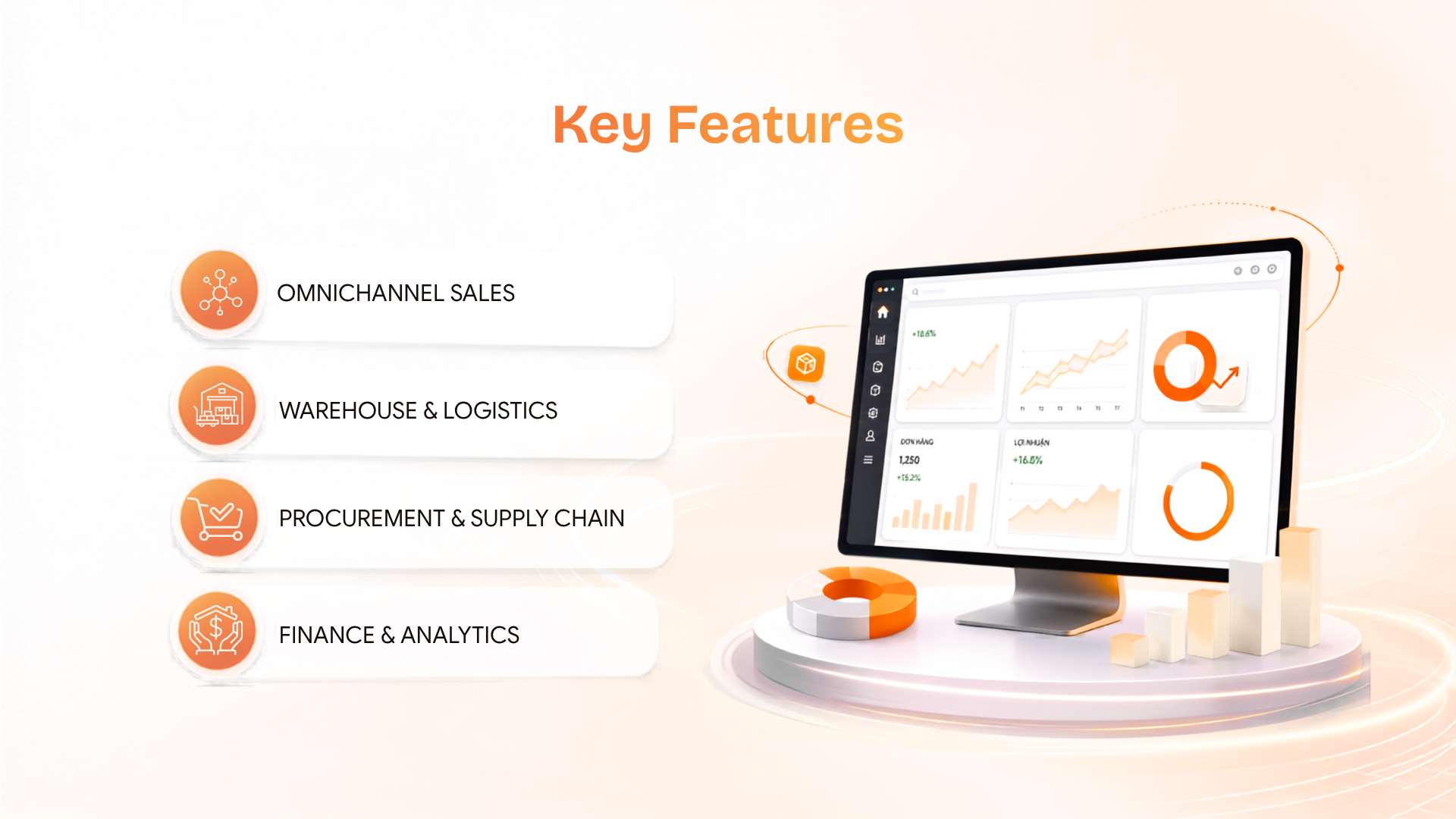
Key features from Leonix
Multichannel sales
Capture all opportunities from customers and track the order process until the order is finalized.
Dynamic pricelist: Automatically apply prices to each customer segment
Warehouse & Logistics
Real-time inventory fluctuations by warehouse, stocktaking using barcode.
The shipping order is generated directly from the order.
Closely manage activities in the warehouse.
Purchasing & Supply
Automatically suggest purchase orders when inventory falls below the minimum threshold.
Calculate the landed cost accurately according to the formula.
Compare prices among suppliers.
Finance & Analysis
Control internal ledgers, accounts payable, and P&L by channel and product.
Real-time dashboard and complete trace log.
Issuing electronic invoices E-invoice
Link and reconcile with banks.
4.2 Implementation Roadmap
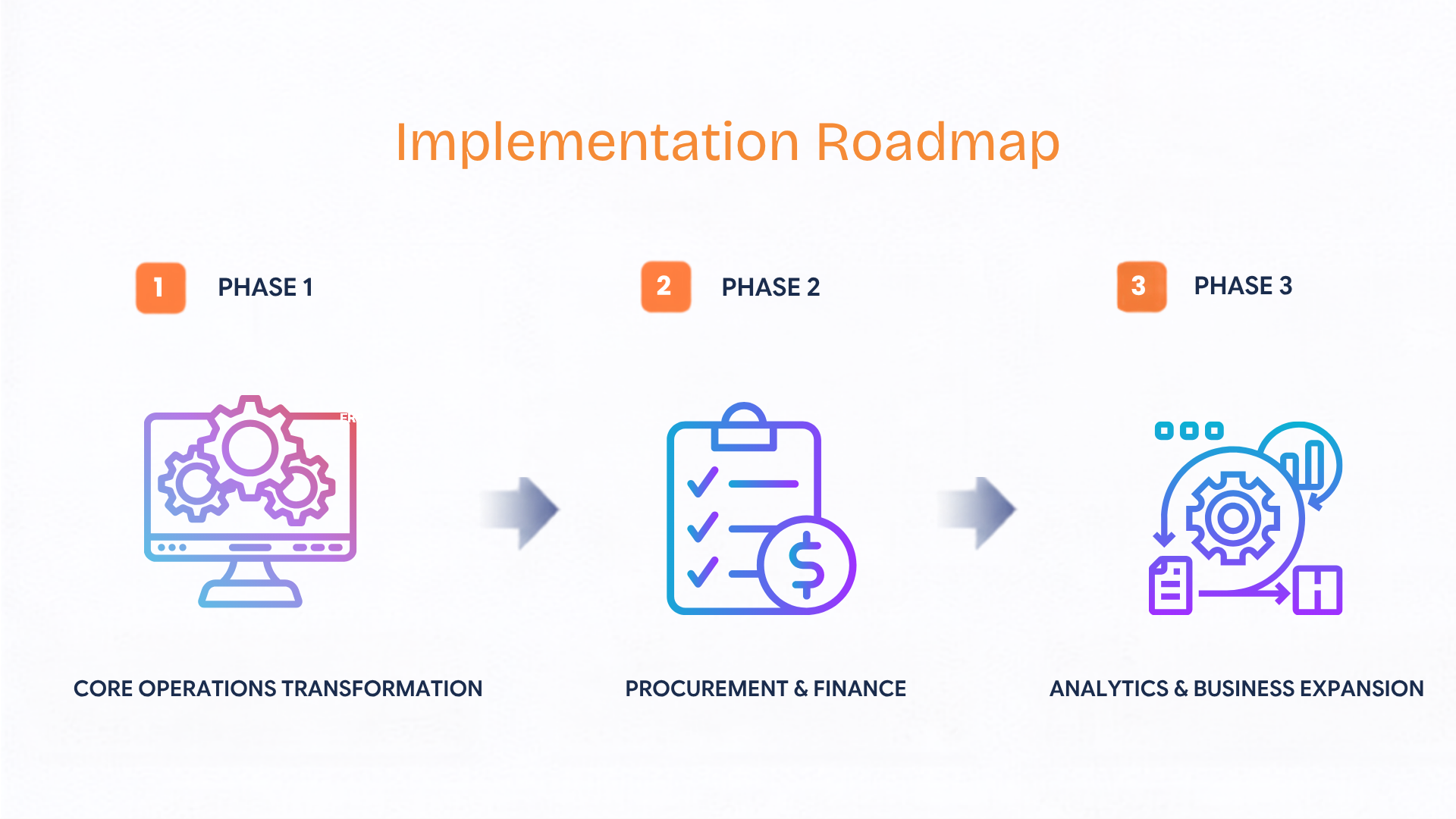
Implementation Roadmap
Phase 1: Replace the core operating system.
Modules include: CRM, Sales, Inventory, Invoicing, Purchase.
Consolidate all purchase and sales orders into a single system.
Tighter control of inventory and sales activities.
Eliminate operational dependence on Excel files.
Phase 2: Purchasing & Finance
Modules include: Manufacturing, Accounting, Barcode.
Forecast purchasing plans based on historical data.
Detail all raw materials (BOM).
Calculate the landed cost of inventory and overhead costs incurred during production.
Consolidated accounting reports.
Phase 3: Analysis & Expansion
Modules include: Marketing automation, eCommerce.
Manage direct sales channels on the website through Odoo.
Expand and enhance marketing campaigns and programs
At Leonix, we believe that a unified data source is a prerequisite for making accurate and effective operational decisions. This is also what businesses seek in the context of scaling up in the face of fragmented data challenges that lead to uncontrollable profit margin losses.
View details about the trade industry solutions
V. Success stories of partner businesses
5.1 Golden Stork Hi-Tech Group
Company introduction
It is a large-scale agricultural supply chain - trade with 50 years of experience in crop nutrition production. The company has 4 modern production line factories and a skilled workforce of over 1000 employees.
Leonix helps businesses digitize import flows & customs documents
Previously, customs documents (EDO, B/L) were scanned files that had to be entered manually and were not linked to the PO or the warehouse receipt. Leonix digitized the entire process on Odoo by addressing the main bottlenecks:
Category | Current status | Results |
Document entry | Manually enter container, seal, declaration from PDF scan file | OCR auto-extracts, directly attaches to PO |
Linking & logistics | Discreet documents, not attached to PO / warehouse receipt | Quotation → PO → Receiving order → Inspection |
Traceability & audit | Not reconciled, cannot be traced | Full process traceability, with change logs |
Authorization | Loose, original files scattered | Role-based authorization, with original files securely stored |
Payment reconciliation | Manual with purchase orders | Bank integration & electronic invoicing, automated |
Import costs | Difficult to separate by batch | Allocate import costs by each shipment/formula |
5.2 Alfalfa Nails
Company introduction
It is a business operating for over 31 years, distributing Retail, Wholesale, and eCommerce in nail services with 1300 SKU products, 9 logistics points, 5 sales channels, and serving 22,000 customers.
Leonix helps businesses consolidate B2B & B2C distribution networks
Previously, the business faced a patchwork operation between DBA Manufacturing, QuickBooks, and dozens of Excel files, with no common data source. Leonix helps resolve the following bottlenecks:
Category | Current status | Results |
Operating System | Fragmented DBA + QuickBooks + Excel | A single Odoo platform |
Sales Process | No specific process | Create a specific process: Flow: Lead → Quotation → Order → Payment → Invoice |
Multi-warehouse inventory | Manual updates, slow, many errors | Real-time by each warehouse location |
Management Reporting | Slow, lacking perspective | Helps control in real-time, make faster decisions |
VI. Conclusion
An ERP system helps businesses connect data across all departments, standardize processes, and provide real-time insights for accurate and effective decision-making.
With experience in implementing ERP for many domestic and international trading enterprises, Leonix accompanies businesses in building a unified and flexible management platform tailored to each stage of development, helping businesses reduce operating costs, protect profit margins, and create a foundation for long-term growth.
Contact Leonix for consulting support and to implement suitable solutions for your business. Leonix is ready to accompany you in building business management strategies, accelerating growth, and achieving sustainable development in the digital age.