
Every day that passes is a coin that drifts away. This is not just a saying, but a reality in the Commerce industry. When short-lifecycle goods (pharmaceuticals, flowers, cosmetics, food) are not managed tightly, it leads to losses: waste, high disposal costs, and legal risks when selling expired products.
I. Which industry needs to manage inventory using the FEFO method?
What is First Expired, First Out (FEFO)?
The Commerce sector has a short product life cycle
Industries with short-lifecycle goods and high-quality control requirements include:
- Pharmaceuticals: Compliance with GxP (Good Pharmacy Practice), expiration = not for sale.
- Fresh flowers: Lifecycle of 3-7 days, rapid deterioration, every hour that passes loses value.
- Cosmetics: Shelf life of 12-36 months, but oxidized products will lose quality.
- Fresh food: Highest waste rate, needs to ship according to FIFO or FEFO principles.
- Food & Beverages: Long supply chain, many intermediate warehouses, difficult to control.
For these industries, inventory management is not a technical issue but a matter of business survival.
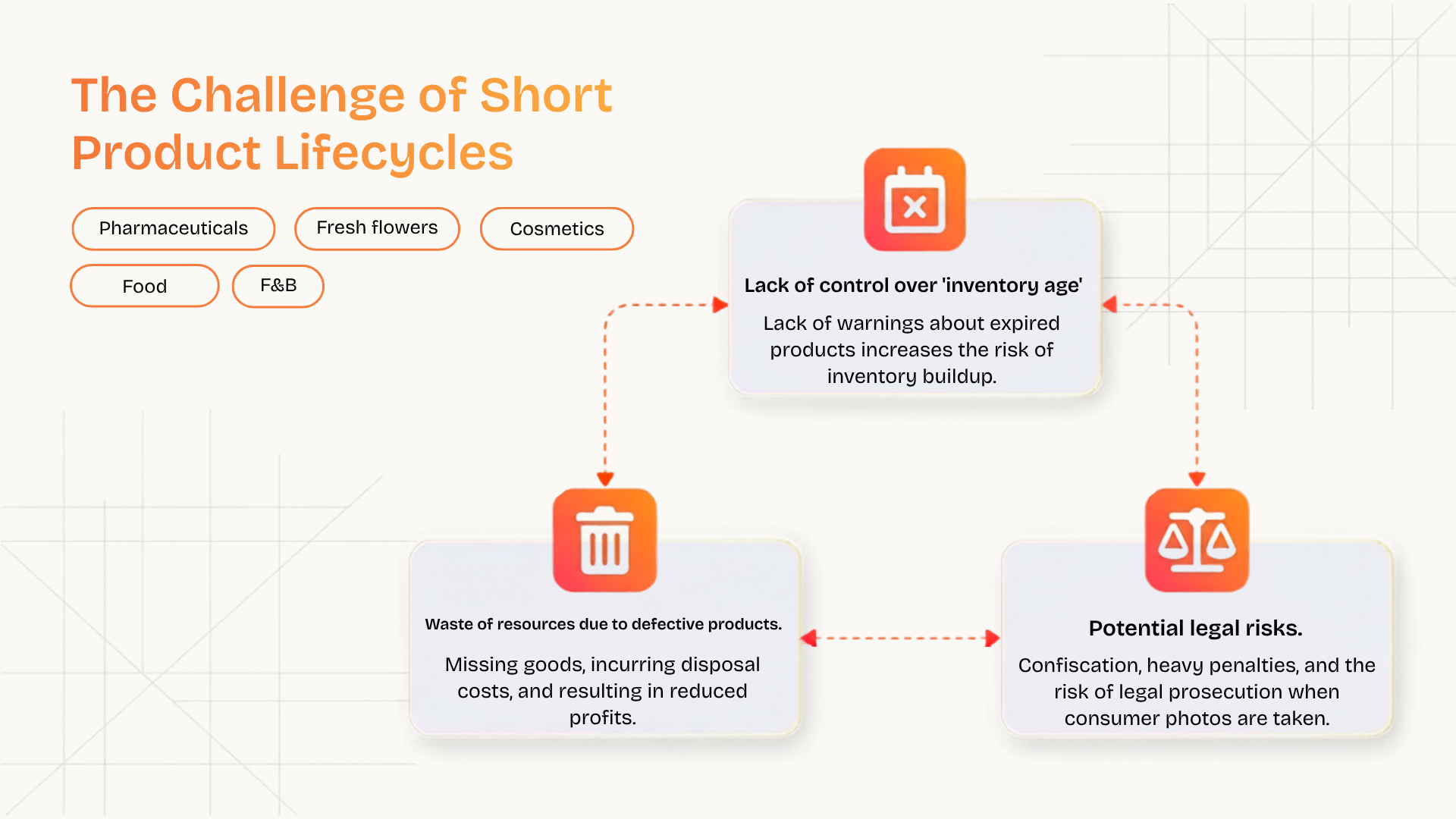
The challenges of short-lifecycle products in inventory management
Exploring FEFO addresses the issue of expiration date managementAt Leonix, we believe that:
In modern commerce, the biggest challenge is not just selling but alsorisk managementfrom expired inventory. A delay in a stocktaking cycle can mean losing millions of VND in legal risks when selling products that do not meet quality standards to consumers.
II. 3 direct impacts when not managing by product lifecycle
1. Inability to control inventory age & Expiration dates
When managed manually, there are no alerts for warehouse staff to know that this batch is about to expire. The consequence is that goods remain in the warehouse for too long, incurring unnecessary handling costs, and cannot be quickly retrieved when there is suspicion of expired goods.
2. Waste of resources due to scrap
Expired products are overlooked during the shipping process, leading to high disposal costs, eroded profits, and decreased operational efficiency of the entire warehouse process.
3. Serious legal risks
This is the most dangerous issue. If expired goods are accidentally sold, the business may have its goods confiscated, face fines of up to hundreds of millions of VND, and even be subject to criminal liability if it affects consumer health, while also damaging the brand's long-term reputation.
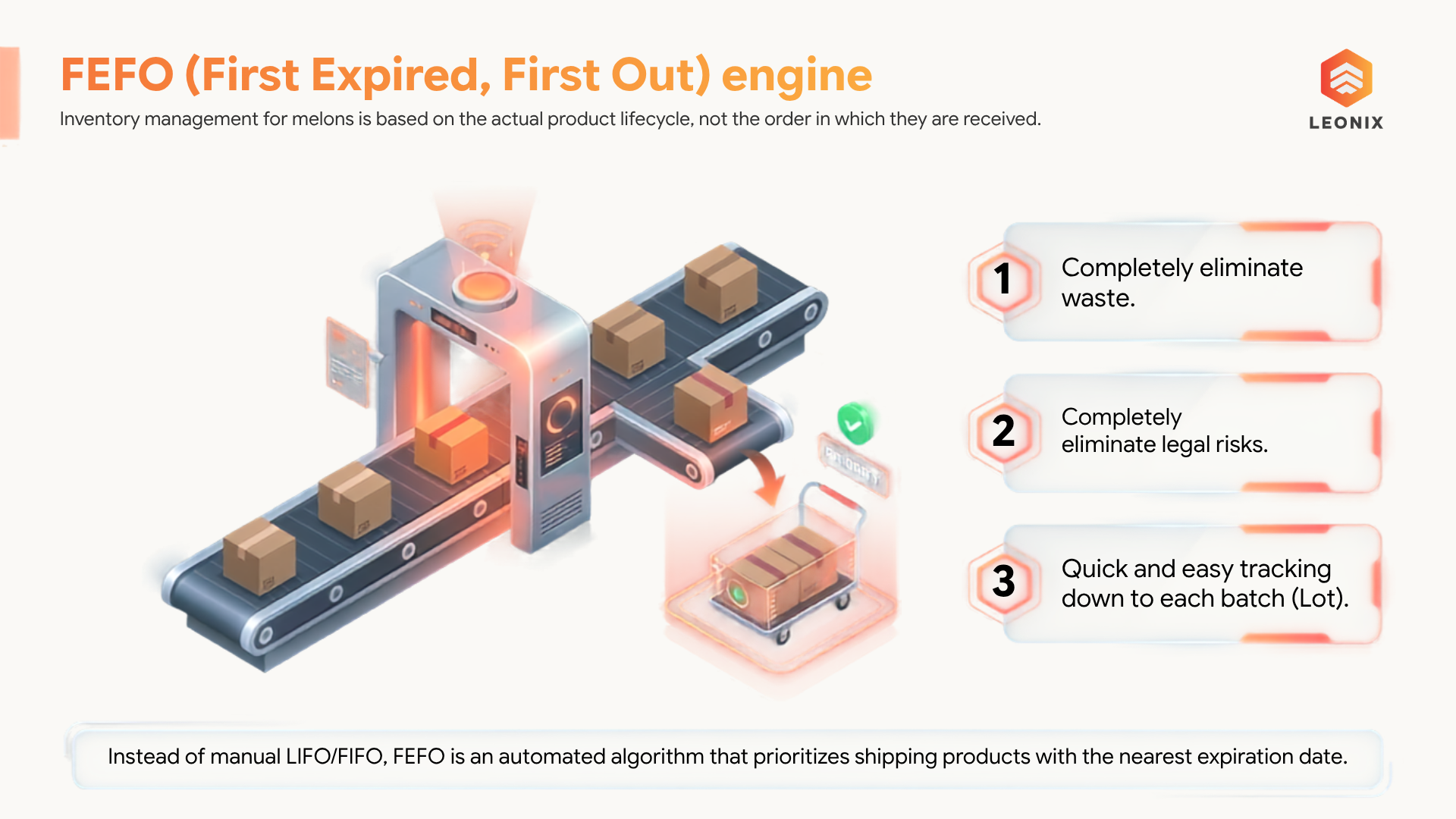
Financial and legal risks when businesses cannot control the expiration dates of goods
III. What is FEFO (First Expired, First Out) & Why do businesses need it?
Definition & Operating Principles
FEFO (First Expired, First Out)is an inventory management method based on the principle of "first expired, first out," prioritizing the dispatch of products with the nearest expiration dates. Unlike FIFO (First In, First Out) - which dispatches in the order of entry - FEFO prioritizes.the age of goods.more than the time of entry into the warehouse.
Real-life example:Batch A was received in January, expiring in December. Batch B was received in June, expiring in September. With FEFO, Batch B will be dispatched before Batch A (even though it was received later) because it expires sooner.
5 Main Benefits of FEFO
Benefits | Direct impact |
Prevent waste | Prioritize shipping products close to their expiration date to minimize the risk of spoilage. |
Prevent legal risks | Ensure that no expired goods are dispatched, avoiding confiscation and administrative penalties. |
Optimize operational efficiency | Accurate inventory control, reducing confusion during operations. |
Quality control | Consistently monitor and manage the product lifecycle. |
Early risk detection | Alert for items nearing expiration and quickly trace each batch for handling. |
IV. Case Study: Apply FEFO
In the FEFO projects of Leonix in the Commerce sector, standardizing product parameters (Production date, Expiration date, Warning date, Disposal date) is the core foundation to eliminate errors in the manual dispatch process. Through practical implementation experience, we can see (Production date, Expiration date, Warning date, Disposal date) are the core foundation for eliminating errors in the manual shipping process. Through practical implementation experience, we can see 3 outstanding features of the FEFO solution
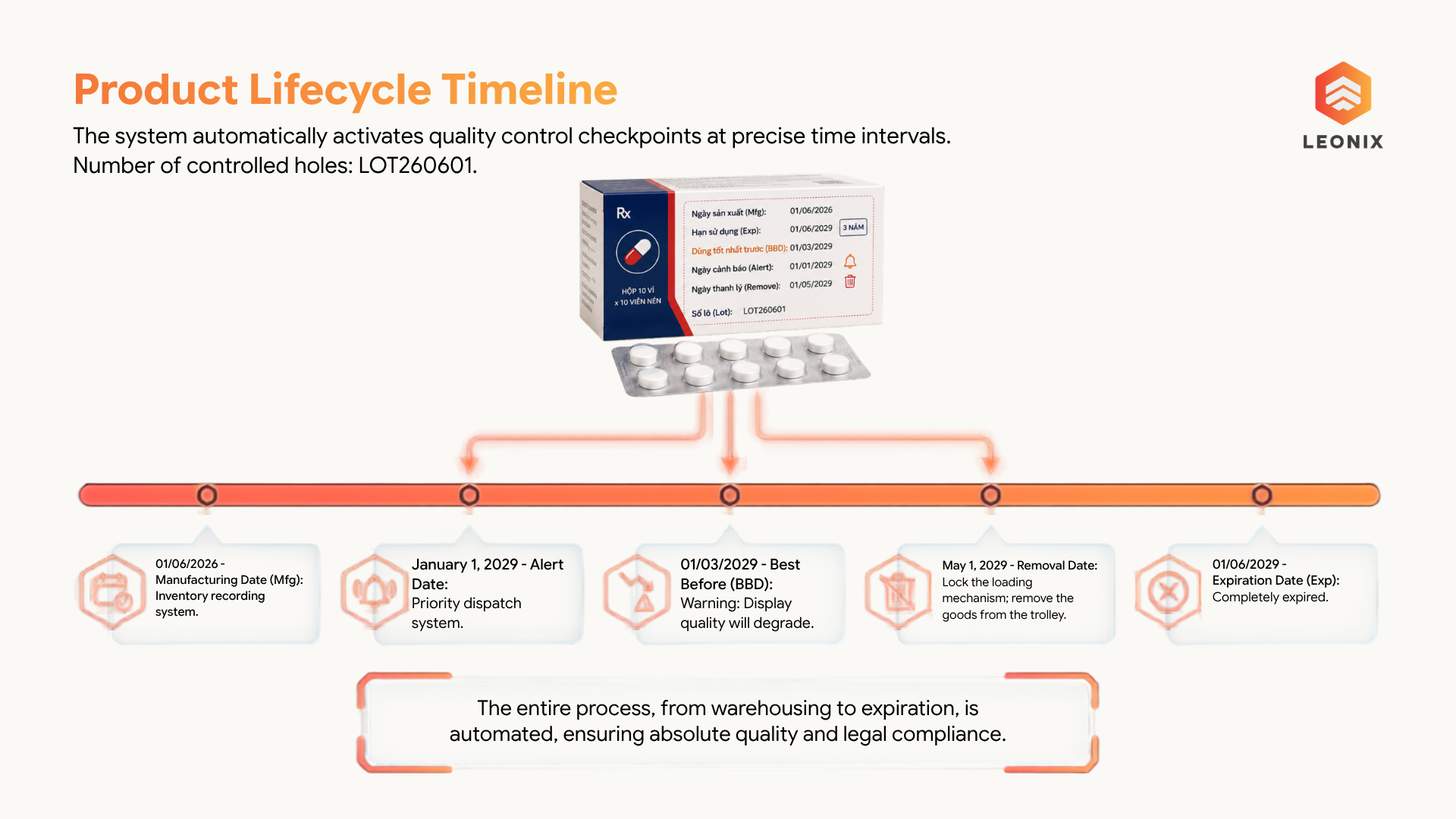
Standardization of batch data and expiration dates on the management software system.
1. Standardize product parameters
Input products require an expiration date and Lot number. Each lot is recorded separately with the following parameters: Manufacturing date (Mfg) - when the product is produced, Expiration date (Exp) - the last date it can be used, Best before date (BBD) - the date of best quality, Alert date - when urgent dispatch is needed, Removal date - when it must be discarded.
2. Visual merchandise rotation
Warehouse staff can easily control which lot is being picked and its location in the warehouse. Trace products, monitor internal inventory movement between warehouses and shelves.
3. Strict quality control on a regular basis
Incoming inspection - confirm that the incoming products meet the specifications. Daily inventory checks - early detection of damaged products. Outgoing inspection - ensure that products leaving the warehouse meet quality standards.
"Inventory does not lie. FEFO does not replace the warehouse manager - it protects them with real numbers."Start implementing FEFO - Immediate assessment required
V. Implementation roadmap in 4 phases
Phase 1: Survey & Data Standardization (week 1-2)
Review the current warehouse process. Standardize the product catalog, expiration dates, and Lot numbers. Identify warehouse locations and zones.
Phase 2: Configuration & Data Migration (week 3-4)
Set up warehouse/zones in the system. Configure FEFO rules and alerts. Import inventory and lot data into the system.
Phase 3: Training & Go-live (Week 5-6)
Detailed guidance for the warehouse team. Run tests with real data. Put the system into actual operation.
Phase 4: Operation & Optimization (Week 7+)
Monitor daily expiration alerts. Refine processes based on feedback. Expand modules as needed.
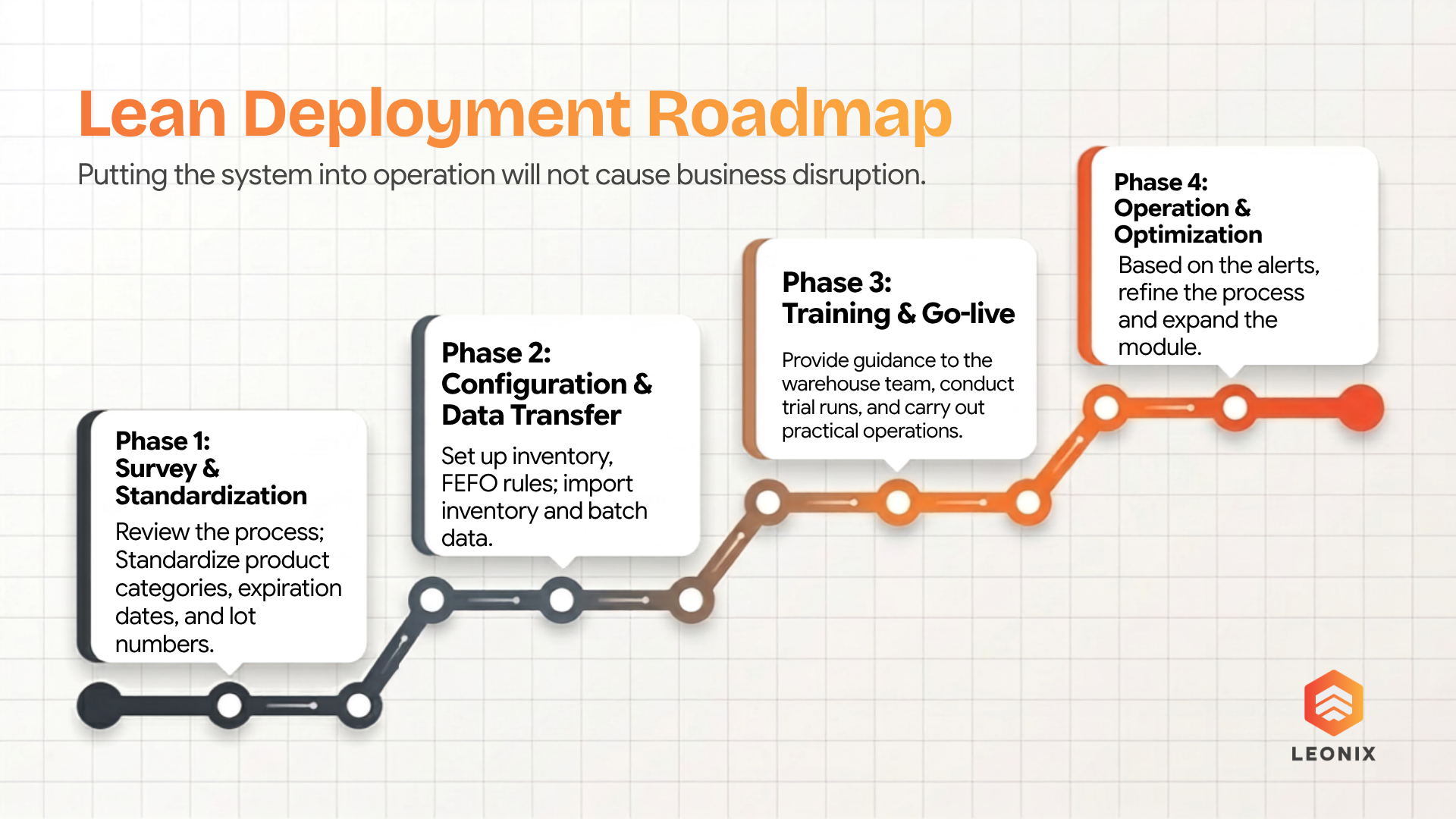
Leonix's 4-phase FEFO implementation roadmap
Conclusion
FEFO is not a complex technology, but a simple yet very effective management principle: Products that expire sooner should be dispatched first. When applied correctly, FEFO not only reduces waste and costs, but also protecting reputation and complying with the law for businesses.
Commercial enterprises like the case study above have demonstrated that a systematic FEFO process + smart systems = significant results. If you also want to experience these benefits, Leonix is ready to accompany you from survey to implementation and continuous optimization.
Next step: Please contact Leonix or learn more about warehouse management solutions to better understand the intelligent system that Leonix has successfully implemented for over 75 projects.
Ready to control inventory & eliminate risks?
If your business is facing challenges in managing expired goods in stock, excessive scrap costs, legal risks from missed items, or non-standardized warehouse processes, now is the time to take action.
Schedule a free consultation with a Leonix expert to assess your warehouse situation in detail, identify bottlenecks, and propose the most suitable FEFO solution.