I. What is ERP? Why does real estate need ERP?
1. What is ERP?
ERP (Enterprise Resource Planning) is an integrated software system that helps businesses manage and automate core business processes on a single platform.
2. Why does real estate need ERP?
The real estate industry has specific characteristics that make ERP an indispensable tool:
Long-term projects with multiple phases
A project typically lasts 2–5 years with multiple phases and complex payment milestones. Businesses must simultaneously track construction progress, budgets, and acceptance. If data is fragmented between departments, control will be slow and prone to errors.
Complex cash flow
Revenue is collected in multiple installments from various clients, while costs include construction, legal, marketing, and operations. This requires accurate cash flow forecasting to ensure liquidity. ERP helps consolidate income and expenses on a unified system, supporting more effective financial control.
Managing multiple stakeholders
Each project involves clients, contractors, banks, investors, and government agencies. The large volume of contracts and transactions requires a centralized system to manage information transparently, avoiding loss and overlap.
Close coordination between departments is needed.
The internal process has a high level of inter-departmental collaboration: sales – legal – accounting – finance; engineering – accounting – contractor payments. Without an ERP to connect data seamlessly, the process can easily experience delays, errors, and difficulties in control.
II. Core features of real estate ERP
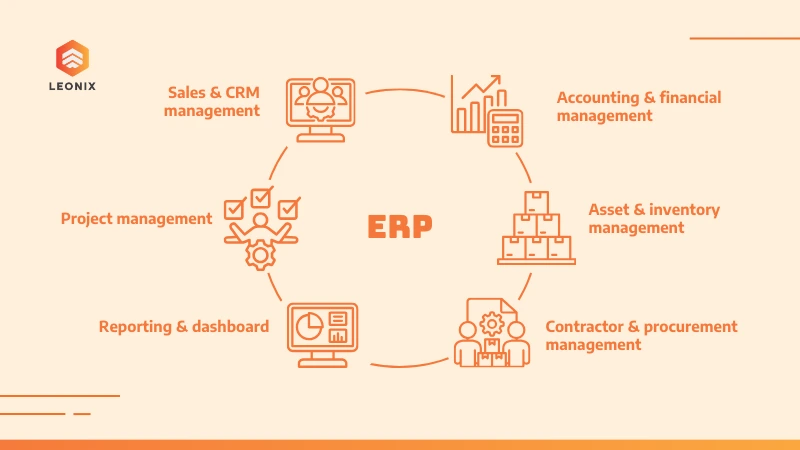
Core features of Real Estate ERP
1. Project management
ERP helps track construction progress by milestone, manage multiple projects simultaneously, and allocate budgets for each phase. Progress is directly linked to acceptance and payment, ensuring that all updates are synchronized in real-time. As a result, businesses know exactly where the project stands, can detect potential delays or budget overruns early, and automatically trigger the next steps when an item is completed.
2. Sales management and CRM
The system manages the entire customer journey from lead to transaction, including sales contracts and payment schedules. ERP automatically reminds of due payments and synchronizes data with accounting, finance, and legal. This helps the sales team stay informed about the status of each deal, reduces the risk of missing customers, and decreases overdue debts, while ensuring a seamless process after contract signing.
3. Accounting and finance
ERP records accounts receivable and payable; manages invoices automatically; generates financial reports such as balance sheets, profit and loss statements, and cash flow. The system can integrate with banks for reconciliation and support tax management as required. Thanks to real-time updated data, businesses significantly reduce the time spent on manual reporting and enhance accuracy in financial management.
4. Cash flow management
The system forecasts cash flow for the next 7, 30, or 90 days, monitors account balances, and alerts for potential shortages. At the same time, the ERP analyzes accounts receivable by age to control recovery risks. As a result, businesses can proactively manage liquidity, prioritize reasonable payments, and mitigate the risk of financial crises.
5. Contractor and procurement management
ERP manages the list of contractors and suppliers; creates and tracks purchase orders; manages contracts and payments based on milestones. The entire procurement process is made transparent, helping to control costs, reduce the risk of delays, and ensure that items are executed as planned.
6. Asset and inventory management
The system manages a portfolio of products such as apartments, shophouses, and land lots; tracks the status of each product (available, reserved, sold). At the same time, the ERP manages fixed assets and construction materials on site. This helps avoid double selling, reduce losses, and optimize resource use in projects.
7. Reporting and dashboard
ERP provides dashboards for each management role, allowing for customizable reports and automatic periodic sending. Data can be cross-analyzed by project, time, or personnel. As a result, management has an overall view, makes data-driven decisions, and significantly saves time on manual reporting.
III. ERP/CRM/Project management software: how do they differ?
1. Comparison table of the three software
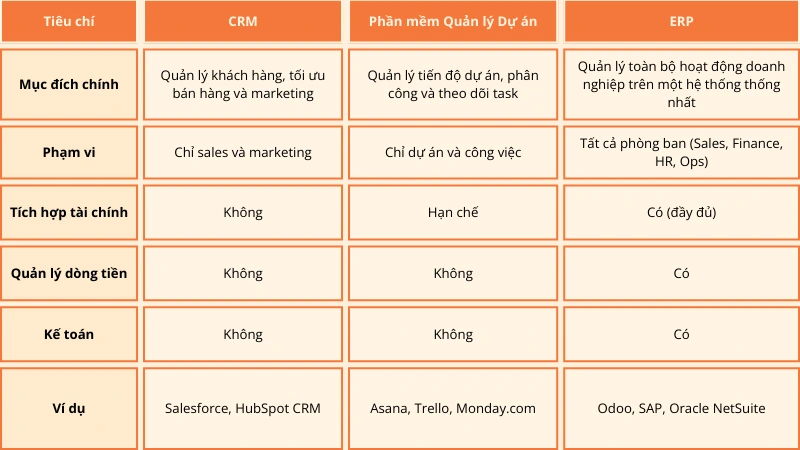
Comparison table of ERP, CRM, and Project Management software
2. When to choose CRM, project management software, or ERP
If a business only needs to manage customers and the sales pipeline, especially on a small scale,CRMis the appropriate choice. If the team primarily works on a project-based model and needs to control tasks,project management softwareis sufficient. However, when a business has three or more departments such as Sales, Finance, Operations, HR; a close connection between sales – finance – projects is needed; and cash flow becomes complex, thenERPis the necessary solution.
For the real estate industry, where it is necessary to manage sales, finance, construction, and legal aspects simultaneously, ERP is the optimal choice. This system helps businesses maintain comprehensive control from contract signing, tracking construction progress to collecting payments and recognizing revenue, creating a solid foundation for sustainable growth.
IV. Comparison of popular ERP solutions for real estate businesses
The choice of ERP depends on the scale, budget, and operational complexity of the real estate business. Below is a brief overview of the popular solutions available today.
1. Odoo
Odoo is an open-source, flexible, and cost-effective ERP (approximately 30–50 USD/user/month). The system has full modules such as Sales, CRM, Accounting, Project, Inventory and can be deployed in the Cloud or On-premise. It is suitable for SMEs or real estate startups. However, an experienced implementation partner is needed if deep customization is desired.
2. SAP Business One
A globally reputable ERP solution, strong in features and supports multinational operations. Suitable for large businesses (over 200 employees). The downside is the high cost (100–150 USD/user/month), long implementation time, and requires a strong internal IT team.
3. Oracle Netsuite
A cloud-native ERP platform, outstanding in financial management and scalability. Suitable for large real estate corporations (over 500 employees). However, the cost is very high and implementation is complex, requiring in-depth training.
4. Microsoft Dynamics 365
Well integrated with the Microsoft ecosystem such as Office 365, Teams, Power BI, familiar interface. Average-high price (70–120 USD/user/month). Suitable for businesses that have used Microsoft 365 and want seamless integration.
V. Conclusion
Many real estate businesses are hesitant about ERP because they believe the costs are high, the implementation takes a long time, or it is not urgent. However, the costs of not having an ERP are often much greater. Businesses can spend 40–80 hours each month on manual reporting, lose 5–10% of revenue due to slow collections, and exceed their budget by 10-15% due to lack of control.
Meanwhile, ERP typically pays for itself within 12-18 months by optimizing operations and cash flow. If a business is managing 3 or more projects, has over 20 employees, generates over 50 billion/year, or is struggling with reporting and financial management, then ERP is no longer an option but a necessary investment step for sustainable growth.
Completely free business analysis support
Discover the best solutions for businesses.
Collect preliminary data on the current automation process and provide insights from a comprehensive analytical perspective.
Based on specific issues, we will provide tailored solutions to help optimize operations and improve your business efficiency.
Analyze potential issues (e.g., asynchronous data, complex data aggregation, delayed reporting)
Quick 60-second check.. Is your business...
If there are 2 or more signs, your system is eroding profits.
- Wasting time compiling reports
- Sales - Delivery - Accounting data is inconsistent
- No real-time profit visibility
- Budget exceeded but realized too late
- Must ask each department again to ensure data alignment
Get support now
Free - No obligation - Focused on practical solutions