
Fragmented data in real estate is not a technical issue - it is a business issue, determining the ability to control cash flow of the real estate platform, especially when the company has not implemented a unified ERP.
I. Problem: How is fragmented real estate data manifesting in day-to-day operations?
When asking a real estate manager: "Where is the data currently stored?", the answer often does not lie in a single system. The shopping cart is in Excel, customer information is managed by sales, contracts are stored separately by the legal department, and payment data belongs to accounting.
At a small scale, this way of operating may still “work.” However, as the number of salespeople, customers, and transactions grows, fragmented data begins to create increasingly visible bottlenecks.
Sales A and Sales B both hold a unit due to the file being updated asynchronously, leading to transaction conflicts and affecting the customer experience.
When it is necessary to handle transfers or reconcile information, the team has to search for emails, Zalo, Excel files, or data from employees who have left the company.
At the end of the month, data must be manually compiled from multiple sources, often taking 3-5 days and prone to errors.
When payment data does not match the transaction, businesses are prone to internal disputes and find it difficult to control cash flow.
Each issue may seem minor, but when accumulated, it creates significant operational costs. Each department uses its own version of data: sales sees one number, finance sees a different number, and leadership has to wait for consolidated reports before having enough basis to make decisions.
"At Leonix, we recognize that fragmented data is not just an operational issue, but a barrier that makes it difficult for leadership to identify risks in a timely manner and miss opportunities during market recovery."
II. Solution: Unifying data on an ERP platform
Adding another standalone tool often does not address the root of the problem. On the contrary, without a clear data architecture, businesses can create even more "data fragments."
What real estate platforms need is a unified ERP system, where the shopping cart, customers, contracts, payments, and reports are connected in the same data flow, updated in real-time.
A suitable ERP system can help businesses:
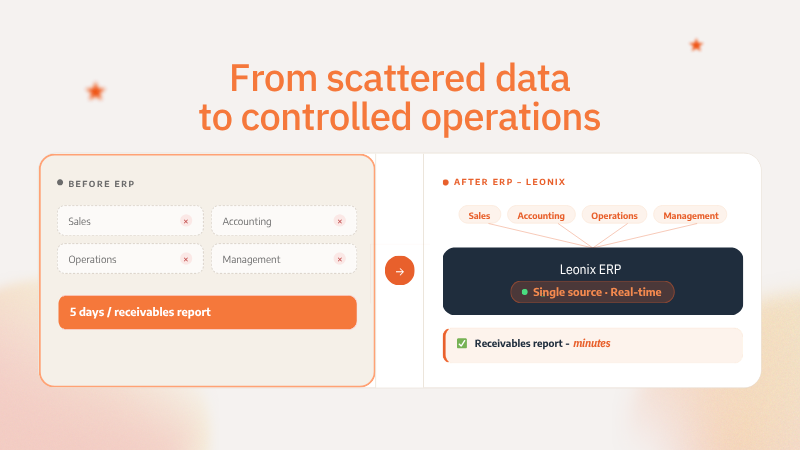
From fragmented data to controlled operations
- Instantly update apartment status: Reduce double bookings and help the sales team work on the same dashboard.
- Automated payment scheduling: The payment schedule is generated according to the sales policy, minimizing manual processing.
- Track cash flow in real-time: Leadership can view revenue, receivables, and actual cash flow at any time.
- Comprehensive customer history storage: Data is not dependent on individual persons or separate files.
ERP does not replace the role of humans in management. On the contrary, the system helps standardize data, reduce information discrepancies, and provide a reliable basis for leaders to make decisions more quickly and confidently.
III. Case study: From Discrete Data to Real-Time Control
In the real estate ERP projects that Leonix has implemented, a floor with a scale of 200 sales once took up to 5 days to compile receivables reports due to data being scattered across multiple Excel files and disparate tools.
Recorded results
8% → 2%
Receivables loss reduced to below 2%
+15 milion
A dashboard boosts sales performance
1 hour
Revenue reports available instantly
Leonix has streamlined the data flow: the sales team updates bookings in the system, contract information is synchronized with the legal department, while accounting can track payments and debts in real-time.
See more articles ERP for real estate businesses - Comprehensive guide →
IV. Conclusion: Whenshould real estate companies implement ERP?
Fragmented data is one of the major barriers that is often overlooked in real estate operations. The issue is not with the capabilities of each department, but with the fact thatthe management system has not kept pace with the growth scaleof the company.
When data is unified on an ERP platform, companies can better control their shopping carts, customers, contracts, payments, and reports. More importantly, leaders canmake decisions based on real datainstead of waiting for manual reports days later.
If your platform is experiencing data duplication, slow reporting, or lack of synchronization between departments, consult with a Leonix expert to reassess the current operational system.
Read more Real Estate in Times of Turmoil: Why ERP Becomes the Coordination Center of Real Estate Companies? Read more Real Estate in Times of Turmoil