For service businesses, management is not just about sales. As the scale expands, having data scattered across multiple software will slow down decision-making and quickly reduce actual profits. It's time for businesses to need a centralized ERP system.
I. ERP solutions and their core role in business management software
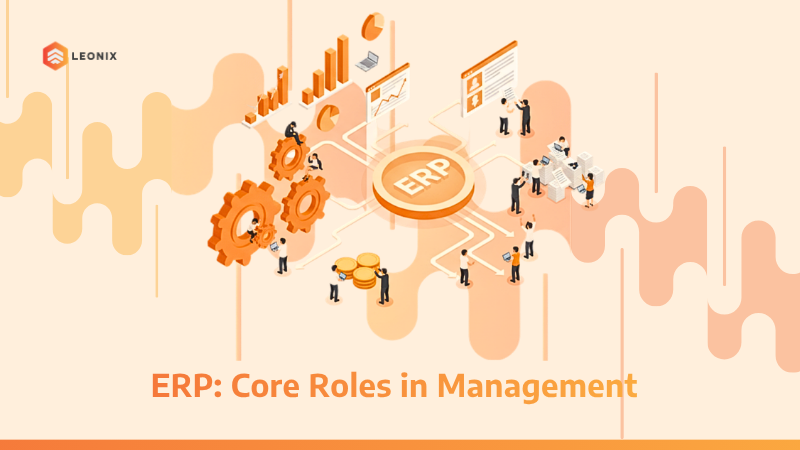
ERP solutions and their core role in business management software
Many businesses make the mistake of viewing the implementation of an ERP system as merely replacing software. In reality, ERP solutions are the foundation for re-establishing management capabilities based on centralized data, helping to synchronize processes across Business, Operations, Accounting, and Human Resources. Among current ERP software, Odoo is rated as the most flexible business management software for the service industry.
With the nature of the service industry, ERP software plays a role in seamlessly connecting the value chain: from managing potential customers, quoting, executing services to reconciling costs and automatically reporting profits. This is not just a supporting tool but also the "backbone" of the digital transformation strategy, helping businesses optimize resources and break through operational performance.
At Leonix, we believe that: Data does not lie. In the service industry, a delayed decision in a reporting cycle can mean losing control over hundreds of millions in hidden costs. The ERP system does not replace the operator's capabilities, but it protects those capabilities with real numbers.
II. 7 Signs You Need to Replace Your Old Management Software with Odoo ERP
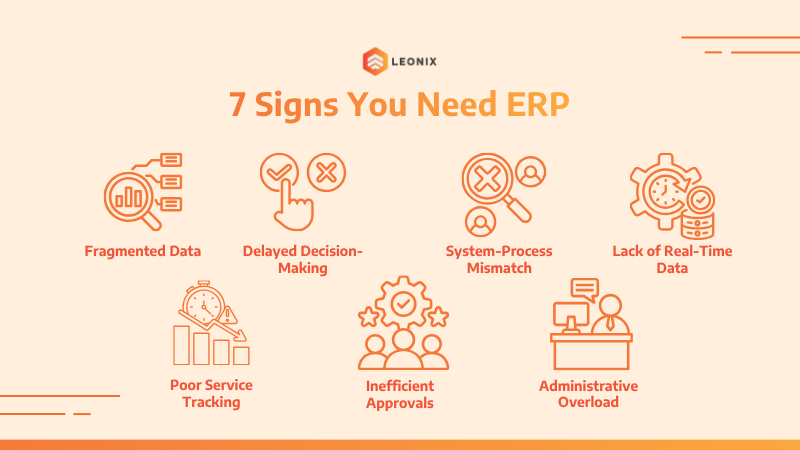
7 Signs You Need to Replace Your Old Management Software with Odoo ERP
If your business is facing the following situations, it is time for the old tool to become a barrier:
1. Data is scattered across multiple tools:
Instead of having a centralized data source, the company's information is fragmented in many places, such as revenue data in accounting software, customer information stored in customer management (CRM) software, while costs are managed manually. The lack of a unified management software causes staff to spend a lot of time reconciling, easily leading to data discrepancies, creating communication barriers between departments, and hindering the control of information flow.
2. Difficulty in making immediate management decisions
Management cannot immediately answer core questions such as which agreements are actually generating cash flow, what the profit margins of each project are, or where inventory risks are arising.
The lack of multidimensional management reports forces managers to make decisions based on guesswork rather than actual statistical data, leading to the risk of missing business opportunities and potential unpredictable financial risks for the company.
3. The actual operating process is not synchronized with the software system.
Many complex workflows have been implemented in practice to serve customers but are not accurately reflected in the management system, leading the company to rely entirely on human memory or manual prompting.
As a result, standardization is disrupted, and when there are personnel changes, the entire workflow will be interrupted, significantly reducing overall operational efficiency.
4. Lack of a real-time data update system.
The board of directors is always in a passive state, having to wait for manually compiled reports via Excel at the end of each week or month to grasp the business situation.
The delay in data compilation causes the company to lose the ability to respond flexibly to market fluctuations, meaning that by the time management identifies a bottleneck, the damage or waste has already occurred.
5. Difficulty in measuring effectiveness for each service.
The current system only allows management to see the overall revenue picture without being able to delve into the analysis of resource, personnel, and material costs for each specific service or project.
The absence of these detailed measurement tools limits the ability to assess performance, complicating the optimization of the investment portfolio and easily leading to a situation where revenue increases but actual profits decline for unclear reasons.
6. Cumbersome approval process.
The operational process is stalled when a quote, contract, or purchase request takes many days to be signed back and forth through the Email system or internal chat applications.
The lack of automation in approval flows not only reduces the team's work efficiency but also causes the business to lose its competitive advantage, diminishing the customer experience due to excessively slow response times.
7. Admin pressure weighs heavily on personnel
Staff in many departments spend hours each day just performing repetitive tasks such as copying, reconciling, and pasting data between different software platforms. This situation not only wastes high-quality human resources on manual tasks but also reduces creativity, increases pressure, and raises the risk of operational errors in the business process.
IV. Practical lessons for implementing ERP and optimizing management software effectively
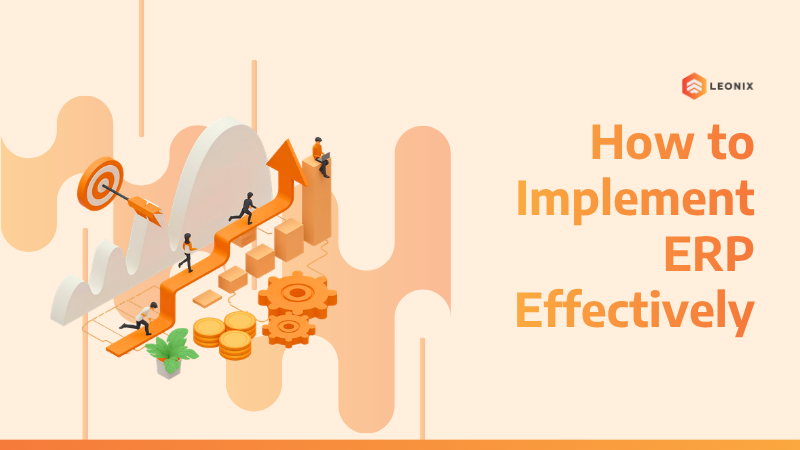
Practical lessons for implementing ERP and optimizing management software effectively
In Leonix's service industry ERP implementation projects, establishing a seamless data flow is the core foundation to eliminate the "information silos" between the Sales, Operations, and Accounting departments. From practical experience, we summarize the following success factors:
Processes must be clear before being put into the system: Software cannot create processes on its own. Businesses need to clearly understand who does what, at which step before digitizing.
Data must be standardized: Clean up junk data, establish standard information fields (Data Standard) before moving to the new home.
People determine success or failure: No matter how great the tools are, if the team's mindset does not embrace innovation, the project will still fail. The determination of leadership is key.
Adopting a flexible implementation approach: This is the key to decoding the question of what is digital business transformation. It is not just about installing software, but about changing the operational mindset. Not every business is suited to the rigid Waterfall model, especially when the project point of contact (SPOC) is not IT-savvy. Dividing the project into phases (Gap Analysis based on fixed costs and Execution using Agile/Hybrid models) will minimize the risk of project failure.
V. Conclusion: The roadmap for building future enterprise management software
Maintaining patchwork management tools is only a temporary solution. Investing in a new ERP system is truly a strategic move that helps reshape the future of every service business. When barriers to data dispersion and administrative pressure are removed by a centralized governance platform, leadership will master the ability to optimize profits and enhance operational performance.
The digital transformation journey will achieve maximum effectiveness when harmoniously combining advanced technology, standardized processes, and the flexible mindset of the team. Don't let outdated systems strip away your competitive advantage; start establishing a suitable ERP implementation roadmap today to prepare for a new growth cycle.
If your business is facing similar issues with disparate tools and data governance, consult with Leonix experts to assess your current operational system and build the most appropriate upgrade roadmap.
Business analysis support is completely free
Discover the best solutions for your business.
- Wasting time compiling reports
- Sales - Operations - Accounting data is misaligned
- Quote browser, contracts lasting several days
- No real-time profit visibility and progress (SLA)
- Overloaded staff, high error rate during peak season
Quick check in 60 seconds. Is your business...
If there are 2 or more signs, your system is eroding profits
Get support now
Free - No obligation - Focused on practical solutions