1. The Current State of "Digital Delay" in Vietnamese Enterprises
Although the digital age has permeated every corner of the global economy, many Vietnamese enterprises are still operating in ways from a decade ago. The image of a CEO facing dozens of fragmented Excel reports with inconsistent data from departments is a clear testament to inefficiency.
The Consequences of Fragmented Management:
Information fragmentation: Accounting takes too long (usually 3-5 days) just to close the books. The business and logistics departments cannot find common ground on actual inventory figures.
Wasted opportunities: According to industry reports, loose management processes cause businesses to miss about 25-30% of business opportunities.
High hidden costs: Errors in manual data entry, lack of transparency, and wasted time on non-value-added reports double operational costs.
Compliance pressure: With new government regulations on "Digital Government", electronic invoices (effective from 7/2024), and upcoming data laws, maintaining the old system is not only a technological delay but also a significant legal risk.
2. Breaking Down Misconceptions About ERP
Many businesses are still not keen on ERP due to outdated perceptions. This article clarifies the two biggest psychological barriers:
Prejudice about scale and cost
In the past, ERP was considered a "luxury game" for multinational corporations with costs in the billions. However, the emergence of Cloud-based ERP has completely changed the landscape. With a pay-per-user model, the cost of access has now decreased by up to 70% compared to 10 years ago, making it easier for small and medium-sized enterprises (SMEs) to own a professional management system.
Prejudice about return on investment (ROI)
Businesses often worry about when they will recoup their investment. The reality shows that a well-structured ERP system can provide immediate quantifiable value:
Shortening reporting time: From 5 days to 1 day.
Reducing operating costs: Saving an average of 15-20%.
Optimizing decision-making: Thanks to real-time updated data.
3. Analysis of the Top 5 ERP solutions in the world
3.1. SAP S/4HANA - "The gold standard" for large corporations
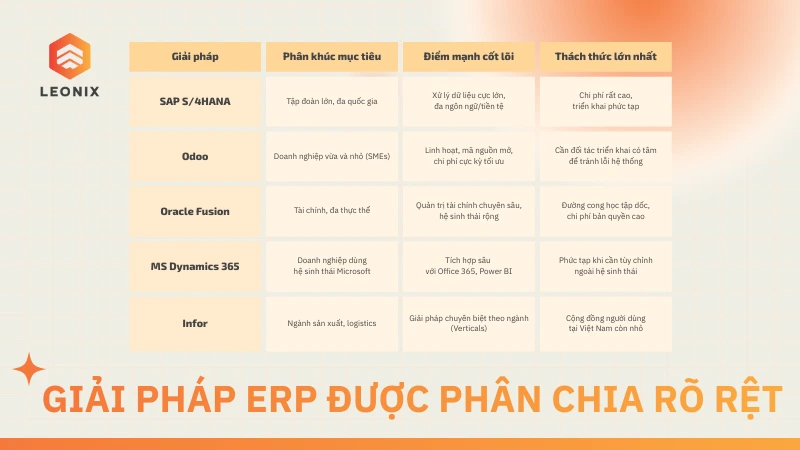
SAP is not just software; it is a global management standard. Using HANA technology, SAP allows for the immediate processing of massive data streams. This is the optimal choice for units that require absolute accuracy in production, logistics, and cross-border finance.
3.2. Odoo - Optimizing opportunity costs for breakthrough growth
Odoowins users over with its modular philosophy. Businesses can start with one application (like CRM) and gradually expand to Inventory, Accounting, Human Resources...
Cost:Ranging from $8 - $30 per user per month.
Advantages:A modern interface, easy to use like social media, with a very large support community in Vietnam.

3.3. Oracle Fusion - The power for financial management
Oracle focuses on the ability to manage cash flow, assets, and revenue recognition for organizations with a multi-entity structure. This is a powerful tool for Chief Financial Officers (CFOs) in controlling transparency.
3.4. Microsoft Dynamics 365 - Seamless and familiar
If a business is familiar with Excel, Teams, or Outlook, Dynamics 365 will provide a seamless experience. The integration with Power BI helps turn dry numbers into visual charts, supporting leaders in making data-driven decisions.
3.5. Infor - Experts in heavy industry
Infor stands out by providing ready-made "tailored" solution sets for specific industries. This helps businesses reduce the need to customize software, thereby minimizing risks during implementation.
3.6. Comparison of ERP solutions:
The current ERP market is clearly divided according to the needs and scale of businesses. Below is a comparison table and detailed analysis:
4. Lessons from implementation (Case Studies)
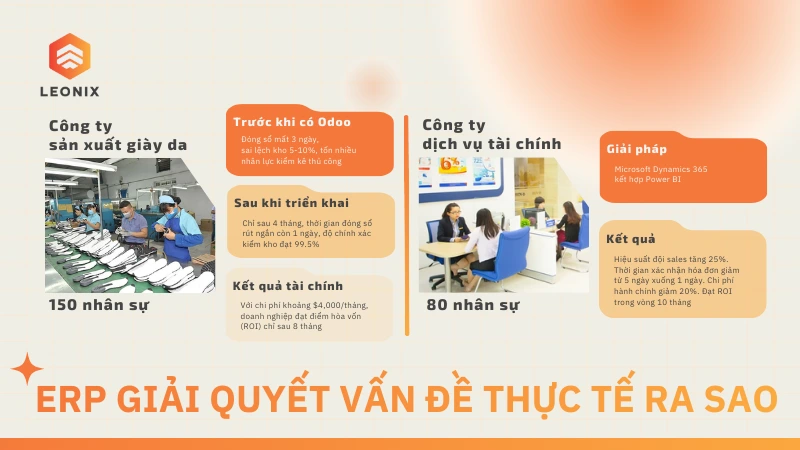
The effectiveness of ERP is demonstrated through two typical cases in Vietnam:
5. Challenges in implementing ERP
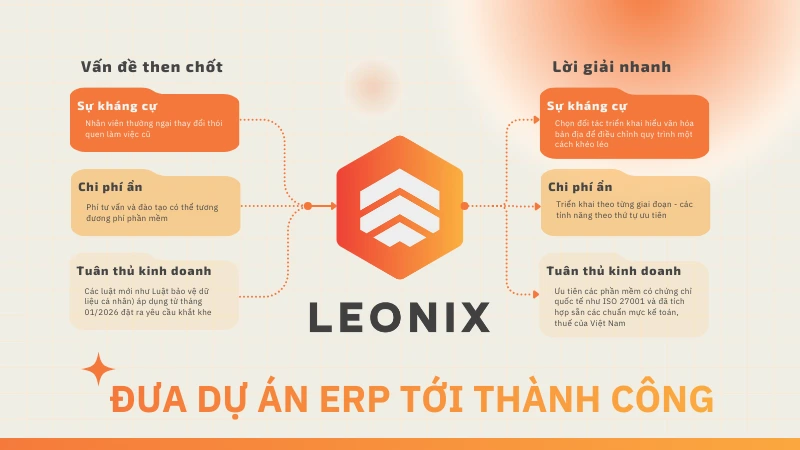
Implementing ERP is not a "bed of roses." Businesses need to face three major challenges:
Resistance to change:Employees often resist changing old work habits.
Solution: Prepare personnel early and choose an implementation partner who understands the local culture to adjust processes skillfully.
Hidden costs:Consulting and training fees can be equivalent to software costs.
Solution: Implement in phases - features in order of priority.
Compliance with data laws:New laws such as the Personal Data Protection Law, effective from January 2026, impose strict security requirements.
Solution: Prioritize software with international certifications such asISO 27001and that has already integrated Vietnam's accounting and tax standards.
6. Conclusion and Actionable Advice
Implementing ERP in the current context is no longer a "nice to have" option but has becomea vital conditionfor competition.
Choosing advice:
Choose Odoo if you are an SME needing flexibility, low cost, and quick implementation.
Choose SAP if you have a large budget and extremely complex processes.
Choose Oracle if your top priority is multinational financial management.
Choose Microsoft if you want to leverage the existing office ecosystem.
Choose Infor if your business operates in manufacturing or logistics.
Next steps
Businesses should proactively contact experienced consulting firms like Leonix - the official Odoo partner in Vietnam to request a real demo. Don't let your business continue to "operate like it did 10 years ago" while the world has advanced into the era of artificial intelligence and automation.