
Traditional management software was only suitable in the early stages, but is now becoming a major barrier to breakthroughs as operational scale begins to expand. This article will help managers understand why real-time management systems are becoming an essential operational foundation for the modern service industry.
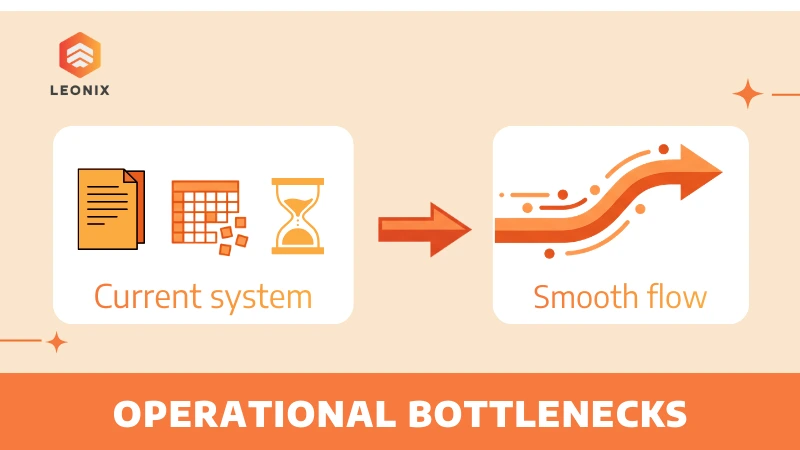
Breaking down bottlenecks, streamlining operational flow
1. As businesses grow, old software becomes an operational "bottleneck"
In the early stages of their careers, many service businesses often choose simple management tools or discrete spreadsheets to maintain basic operational machinery. These tools may initially be sufficient to track customer lists, manage individual project tasks, or control small teams.
However, as businesses enter a phase of rapid growth, with a surge in customer numbers, many projects being implemented simultaneously, the need for personnel coordination and inter-departmental collaboration becomes increasingly complex, while reporting requirements must be faster and more accurate.
When data is not updated in real-time, managers will always find themselves in a reactive state when making strategic decisions based on outdated and unreliable information. This not only wastes resources but also causes the loss of valuable business opportunities in a fiercely competitive environment.
2. Real-time management: The modern operational foundation for service businesses
Smart service management in the digital age is not just about digitizing outdated manual processes, but about the ability to comprehensively connect all operational activities on a single system with real-time data updates. A modern service management system will help businesses closely monitor project progress at the time of execution, thereby creating perfect data synchronization between the business department, the project execution team, and the finance and accounting department.
Instead of spending hours waiting for manual summary reports at the end of the week or month, managers can now easily grasp the entire operational picture through a single Dashboard:
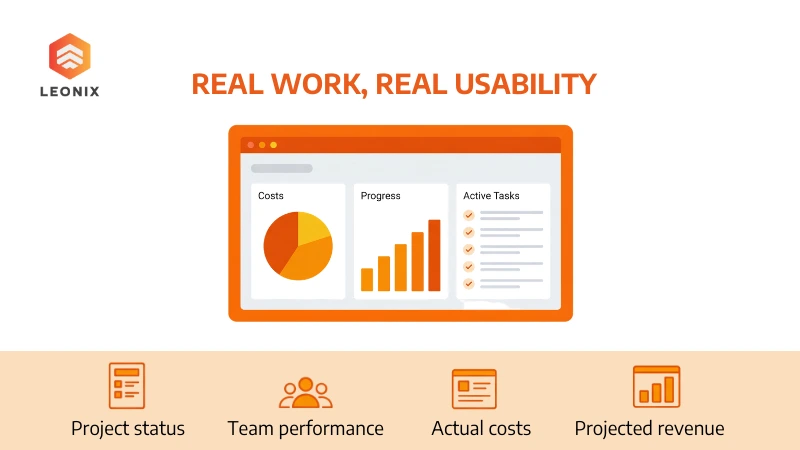
Real-time management Dashboard interface: Comprehensive control
Project status:Detailed updates on each touchpoint and the completion progress of personnel.
Team performance:Accurately measuring the productivity of each individual and department.
Actual costs:Controlling cash flow and expenses as soon as they arise.
Projected revenue:Accurately forecasting profitability to proactively adjust business plans.
This shift is the difference between addressing issues after they occur and the ability to proactively control operations from the start.
3. Why are traditional management solutions no longer suitable for large-scale operations?
Most traditional service management software is typically designed to address individual, discrete processes, lacking the ability to deeply integrate operationally between functional modules. This inconsistency has led to data "silos," forcing employees to perform many repetitive manual checks just to ensure that the data in the system is accurate and reliable.
As businesses continue to scale, these technological limitations not only significantly reduce the operational efficiency of the entire machine but also directly impact customer experience and the company's profit margins.
Breakthrough benefits of transitioning to an integrated service management system
Deciding to replace traditional software with a real-time integrated service management system will bring strategic benefits that help businesses elevate their competitive capabilities in the market:
Operational transparency:Eliminating information barriers so that all departments in the company can see and jointly utilize a single source of data.
Risk control:Early identification of signs of delays or errors in projects to take timely intervention measures before causing harm to customers.
Resource optimization:The ability to allocate personnel and time scientifically based on actual data rather than relying on personal intuition.
Speedy decision-making:Data is always in a "live" state, enabling leaders to react extremely quickly to the constant fluctuations of the service market.

The real-time service management system connects the entire operational cycle of the business.
4. When should a business replace its service management system?
If your business is frequently facing project delays, data discrepancies between departments, or leadership spending too much time on manual report compilation, these are red flags indicating that the current system is overloaded. Continuing to rely on outdated tools not only hinders growth but can also become the biggest barrier preventing your business from keeping up with industry competitors.
Conclusion: In a volatile service environment, response speed and data control capabilities are key to maintaining sustainable growth. Changing the management system is not just a pure technological upgrade decision, but a strategic move to restructure operational capabilities for the next breakthrough phase of the business.
Contact Leonix to build the governance system of the future.
If your business is in the expansion phase and wishes to build a professional real-time service management operating system, Leonix is ready to accompany you from the process survey step to successfully implementing the optimal solution.
Completely free business analysis support
Discover the best solutions for businesses.
Quick 60-second check.. Is your business...
If there are 2 or more signs, your system is eroding profits.
- Wasting time compiling reports
- Sales - Delivery - Accounting data is inconsistent
- No real-time profit visibility
- Budget exceeded but realized too late
- Must ask each department again to ensure data alignment
Get support now
Free - No obligation - Focused on practical solutions