
1. ERP and MES: Collaborating to solve the "Gold Balancing" problem.
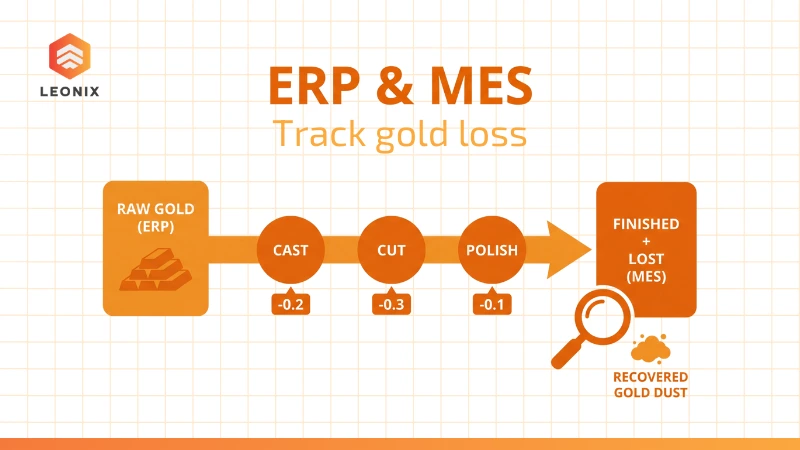
Integrating ERP & MES - Tracking gold loss through each production stage.
To see the clear difference, instead of delving into complex crafting techniques, let's look at the most headache-inducing problem for every gold shop owner: Reconciling end-of-day losses.
For example: You deliver 10 taels of 18K gold to the workshop to craft a batch of rings.
Role of ERP ("Chief Accountant" at the office):
Stock out: 10 units of raw gold.
Expected finished goods in stock: 100 rings. ERP helps you know: "How much capital (gold) have I given to the workshop?"
Role of MES ("Technical Warehouse" at each workstation):
Information from the workshop to the office often has delays or has been "rounded" through a subjective lens. ERP cannot tell you at this moment how much gold is turning into dust and how much is in the safe. To close this gap, the MES system goes into detail to answer the question: "Where has the lost gold gone?"
As the shipment passes through each stage, the MES records the actual data:
After Casting: Obtained 9.8 Taels. -> Loss due to fire: 0.2 Taels.
After filing: Obtained 9.5 units. -> Mechanical loss: 0.3 units (Need to recover from dust).
After Polishing: Obtained 9.4 Units of finished product. -> Polishing loss: 0.1 Units.
Result: MES clearly shows you where that 0.6 amount of lost gold is, instead of just reporting generally that "0.6 amount is lost."
If there is only ERP, you see a loss of 0.6 Gold Amount and refer to it as "Loss". You don't know where the loss comes from.
With MES, the system specifies: 0.2 is lost due to fire (acceptable), 0.4 is lost due to filing and polishing. If the actual amount of recovered gold dust at the vacuum machine is only 0.2 amount, it means you have lost the remaining 0.2 amount without a clear reason (possibly due to operational errors or the recovery system not achieving optimal efficiency).
2. When the jewelry workshop only has ERP: The costly "unknowns"
Many workshops today operate under the model: Gold is taken from stock -> Workers work (self-recording) -> Finished products are stored -> Accounting enters ERP. The gap in between is where profits evaporate:
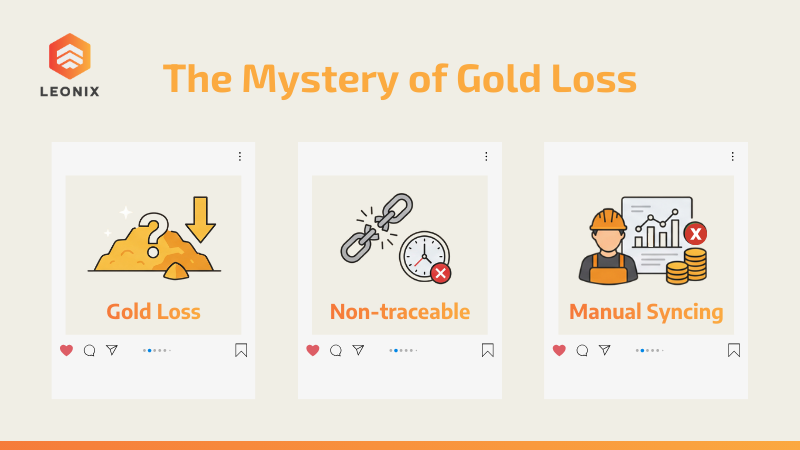
Management issues cause gold to be lost that the business finds hard to control
The "blind spot" regarding losses
Gold does not disappear immediately; it gradually diminishes through the processes. ERP only records the results that are "already done." Without MES connected to electronic scales to record the amount of gold before and after each process, you cannot distinguish between allowable technical losses and abnormal losses.
Unable to trace the history of production
For example, a ring loses a stone or has the wrong gold age during the final inspection. If using a manual process, you will not be able to trace back to know exactly where this error occurred: Was it due to incorrect mixing ratios? Did the cold worker file incorrectly? Or did the worker who received the stone loosen the prongs? When responsibility cannot be clearly assigned, the business ultimately bears the loss.
Wasting time on inventory and reconciliation
At the end of the day, workers and managers have to spend hours measuring and finalizing data with accounting. A small mistake can lead to ongoing internal disputes due to discrepancies between the notebook and the computer.
3. MES: Strictly monitoring the "flow of gold"
There is no need for constant supervision; MES helps you "digitize" the entire transformation process of gold at each workstation:
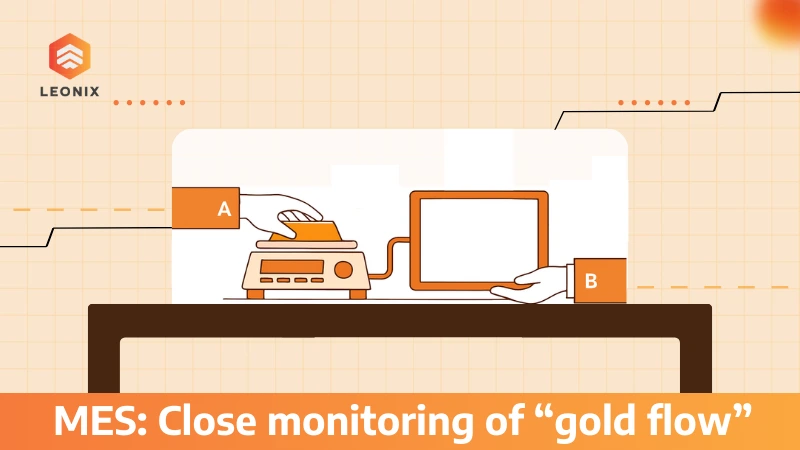
MES - Controlling the flow of gold in workshop operations
Accurately recording handover data
The system connects directly to the electronic scale. When Worker A hands over goods to Worker B, the weight of gold, quantity of items, and product status are automatically recorded in the production management software.
Controlling the mixing ratio
MES displays the standard alloy mixing formula right on the screen in the casting area, forcing workers to adhere to the correct ratios to ensure consistent gold quality.
Evaluating actual productivity
The data will clearly show which workers are fast but have high wastage, and which workers are meticulous but slow. This is a valid database for calculating fair piecework wages that no one can dispute.
4. Why can't off-the-shelf software be used for jewelers?
You may see many places advertising custom software development or selling MES packages for the mechanical, plastic, and textile industries. However, applying it to the gold industry is often ineffective.
Why? Because the gold industry has too complex units of measurement (Taels, Grains, Decigrams, Milligrams, Grams, Carats) and the value of goods fluctuates every second. A standard MES system for jewelers must be "tailored" to handle the multi-unit measurement problem and manage valuable assets, rather than simply counting the number of items like in other industries.
ERP manages capital, MES manages gold
"As profit margins become thinner, every gram of lost gold is a cut into the survival of the business. If ERP is the 'brain' that helps you coordinate capital, then MES is the 'eyes' that guard every gram of gold on the shop floor. Don't let the production process be a mystery; use technology to make every step of the crafting process transparent and optimized."